

The AI Agent Revolution Arrives in Africa
Artificial intelligence is undergoing a fundamental shift. For years, most AI systems have functioned as chat interfaces. Users ask questions, receive responses, and manually act on the results.
But a new paradigm is emerging: autonomous AI agents. These systems do more than respond to prompts—they can monitor events, interpret context, execute tasks, and interact with software tools continuously in the background.
This represents one of the most significant changes in computing interfaces since the rise of APIs and cloud platforms. At Nubis, we believe infrastructure must evolve alongside this new generation of intelligent systems.
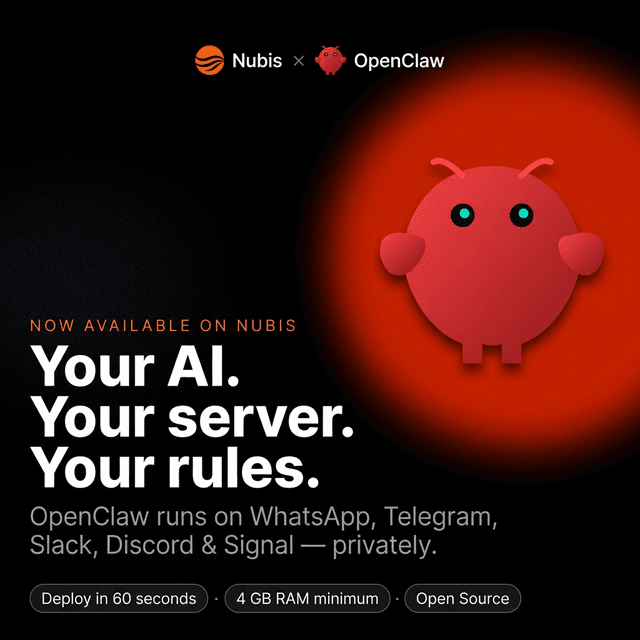
That is why we are announcing that OpenClaw is now available on the Nubis Marketplace, allowing developers and founders to deploy autonomous AI assistants directly on Nubis infrastructure.
With a single deployment, you can launch a private AI assistant that connects to your messaging apps, automates workflows, and operates continuously on your own compute resources.
What is OpenClaw?
OpenClaw is an open-source framework designed for building persistent autonomous AI assistants. Unlike traditional chatbots, OpenClaw acts as a control layer between humans and digital systems.
Instead of requiring users to constantly prompt an AI system, OpenClaw agents can observe incoming information and perform tasks automatically.
An OpenClaw assistant can monitor WhatsApp conversations, summarize Slack discussions, query APIs, run scripts, manage files, and automate operational tasks.
Rather than serving as a chatbot, OpenClaw functions as a programmable digital operator.
Who Created OpenClaw?
OpenClaw was created by Peter Steinberger, a software engineer known for building developer infrastructure tools and open-source frameworks.
The motivation behind OpenClaw was simple: modern AI systems are powerful, but they are passive. They wait for instructions.
Developers wanted systems that could monitor environments, respond to events, and execute workflows autonomously. OpenClaw introduced a framework for building exactly that.
When the project launched publicly, it quickly gained traction among developers. Within days, the repository attracted massive attention from the open-source community, becoming one of the fastest-growing AI agent frameworks because it introduced a system architecture for autonomous digital assistants.
The Evolution of AI Interfaces
To understand why OpenClaw is important, it helps to look at how software interfaces have evolved.
Phase 1 — Manual Software
Traditional software requires explicit user interaction. Users navigate interfaces, click buttons, and trigger operations. The user is always the orchestrator.
Phase 2 — Conversational AI
The next evolution introduced conversational AI systems. Users could describe tasks using natural language. However, these systems still require manual prompting.
Phase 3 — Autonomous AI Agents
Autonomous AI agents represent the next stage. These systems run continuously, observe events, and operate without constant prompts. OpenClaw belongs to this category, allowing developers to build AI systems that actively perform work.
Key Features of OpenClaw
Multi-Channel Communication
OpenClaw integrates with messaging platforms such as WhatsApp, Telegram, Slack, and Discord. Users can interact with their AI assistant directly from messaging apps.
Autonomous Tool Execution
Agents can execute tasks through APIs, CLI commands, database queries, and web browsing. This transforms AI from a text generator into a real execution system.
Containerized Sandboxing
Every tool execution occurs inside an isolated container, providing improved security and predictable execution environments.
Model-Agnostic Design
OpenClaw works with multiple model providers like OpenAI and Anthropic, allowing developers to control cost, latency, and privacy.
AI Agents vs Chatbots
| Feature | Chatbots | AI Agents | | ----------- | ------------ | ------------ | | Interaction | Prompt-based | Continuous | | Context | Limited | Persistent | | Execution | Text only | Real actions | | Automation | Manual | Autonomous |
Running OpenClaw on Nubis Infrastructure
Autonomous AI systems require infrastructure capable of handling persistent runtime environments and container orchestration. Nubis provides infrastructure designed for predictable performance and transparent compute environments.
Deploying OpenClaw on Nubis provides:
- Dedicated compute
- Regional low-latency infrastructure
- Predictable pricing
- Full data control
Deploying OpenClaw in 60 Seconds
- Select OpenClaw: Find OpenClaw in the Nubis Marketplace.
- Deploy Instance: Choose a region.
- Configure Providers: Provide your API keys for OpenAI or Anthropic.
- Connect Channels: Connect WhatsApp, Telegram, or Slack.
Real-World Use Cases
- Founder Productivity: Summarize conversations, draft responses, and track alerts.
- Engineering Operations: Trigger deployments and monitor infrastructure through chat.
- Team Knowledge: Retrieve documentation and meeting notes instantly.
Why Self-Hosted AI is the Future
Organizations increasingly prefer self-hosted AI infrastructure for Data Privacy, Cost Control, and deep Customization.
AI agents will likely become the primary interface for interacting with software systems. Developers building with OpenClaw today are exploring what may become the default computing interface of the future.
About the author
Nubis Team
EngineeringMember of the Nubis engineering team, building the cloud infrastructure Africa deserves.